Timetable Museum
Jikokuhyo-tetsu is a term that refers to railroad fans (hence the tetsu) who revel in collecting and reading timetables published by travel agencies. When I think of jikokuhyo (timetable), the first thing that comes to mind is a Japanese test I barely prepared for—and as with anything requiring preparation that I neglected, I paid a heavy price. Having first encountered the word through my mistake rather than a textbook, it never occurred to me that someone would create a museum dedicated to timetables. Yet by chance, I contacted a man who called himself kancho (museum director). A medical professional by day, he maintains a private collection in Nakano in his spare time as a devoted timetable enthusiast. He named it simply the Timetable Museum. The understated name belies the carefully put up exhibition.
Since the museum only opens on weekends, I sent him an email on Saturday evening with little hope of visiting before leaving Tokyo. Surprisingly, kancho replied that very night. Although reservations were full for the only day I was available, he graciously agreed to let me visit after regular hours. I am immensely grateful for his hospitality despite his busy schedule. The following day, I visited and interviewed him. The conversation follows:
Q: When did you start collecting timetables? What opportunities led you to the thought of collecting them?
A: I started buying timetables every month at the beginning of middle school. It was when I was 12 years old. Since then, I have been purchasing timetables for 45 years. As to the reason for purchasing them, it was because I would receive a monthly allowance of 1000 yen, and the timetables at the time cost 500 yen each. Since the allowance was money I could spend freely, buying the timetables I like with it was a very joyful thing.
Q: Where did you live during middle school?
A: I lived in Nakano. The building I lived in was different, but the place remains unchanged. I was born and raised here.
Q: Through high school and university too?
A: For 4 years, I lived in Aichi Prefecture for university.
Q: The next question is a little bit lengthy… Some time ago, I spoke with a professor in my university who teaches history. The professor said that because research materials can be acquired easily from the internet, the importance of paper material has lessened compared to before. What do you think? Even though we are in the digital age now, what value do paper timetables still hold?
A: Indeed, as the professor said, the necessary information can be inquired from the internet immediately. However, what may happen to the past after time passes? Let’s say after 20 or 30 years, what becomes of the information then? When it comes to researching the state of things in the past, the digital
Q: And so, do you have the same feelings about things like CDs, DVDs or Blu-ray?
A: No, in the end, the equipment for playing CDs as well as the digital storage things would gradually disappear. As such, even if things like CDs or DVDs were to exist, since the machine for replaying would disappear, the digital or data storage would last probably only 10 to 15 years. But paper would last indefinitely. When you go to a museum, you would see things made of paper from 1000 years ago. That is the point, isn’t it? That said, for information you really need right now, I think the internet is fine. But in the end, I think paper is best for records that can be stored for several decades in the future, isn’t it? Well, by the end of the day, paper is physical and real. Although it easily lasts a long time—and easily preservable, too, it does require space.
Q: What do you think the future of railways will be?
A: As for railroads, I don’t think it is going away, but I wonder if the truly necessary railroads and the ones that are not would diverge. After all, since the total population is decreasing, the number of people who ride trains is also decreasing. To someone like me likes railways, that’s sad; as a matter of reality, when passengers become fewer, railways do disappear. That’s worrying. In places like Tokyo, you don’t feel that people are decreasing, but in rural areas of Japan, people are decreasing, aren’t they? When that happens, the necessity of railways weakens. I have that feeling.
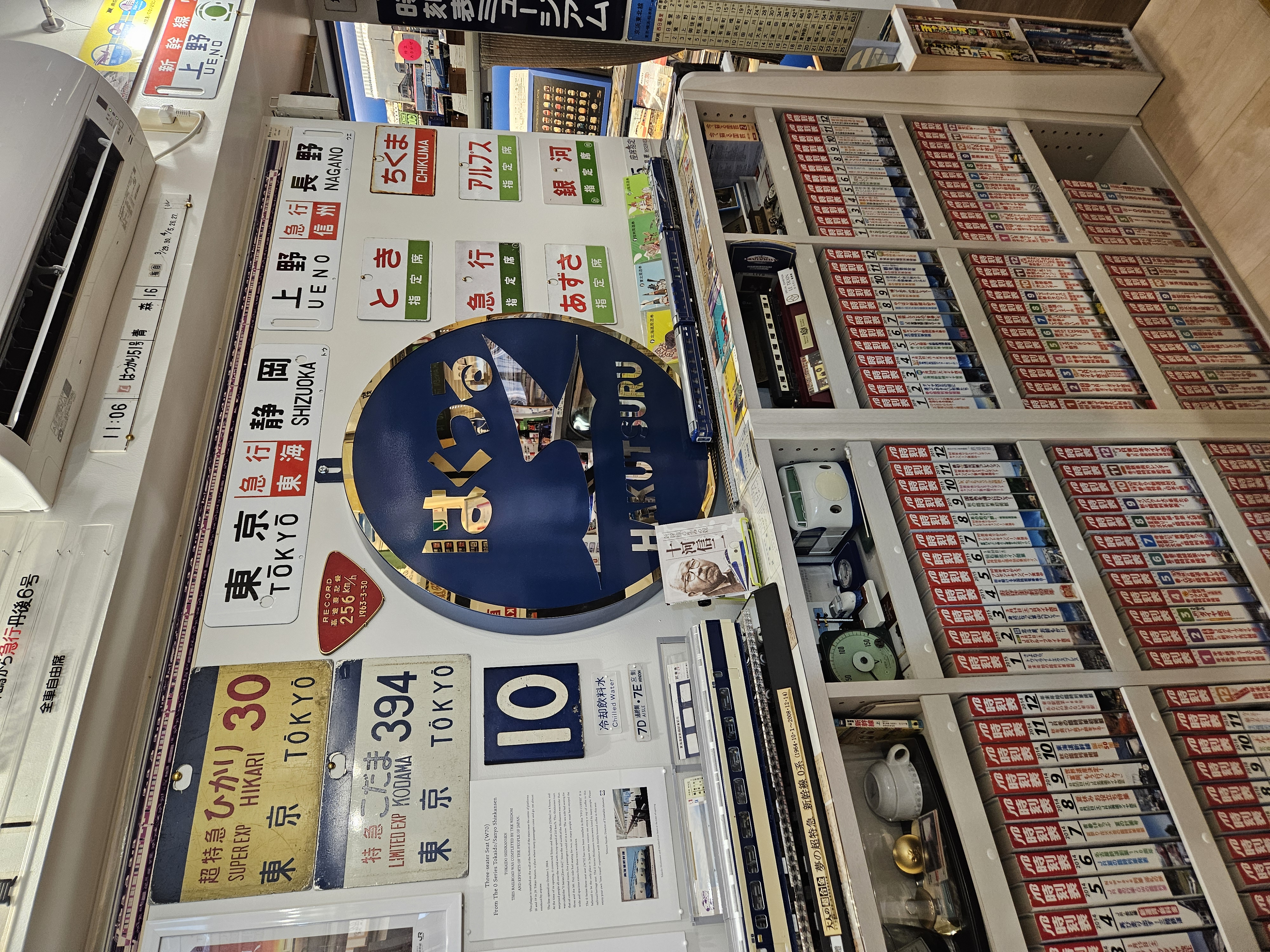
Following our interview, kancho generously showed me his timetable collection, an experience I found truly eye-opening. He had acquired them through various channels: purchasing new editions, receiving them as gifts, or finding them in kosho-ten (used book stores). My curiosity led me to ask about his oldest timetable, and he promptly presented one with “Taisho Year 5” (1925) emblazoned on its cover. The presence of tetsudo-sho (Ministry of Railway) above the title further underscored its age . As I flipped through the pages, I was struck by how much looked familiar. Aside from Hokkaido’s steadily shrinking railway network, most station names, administrative divisions, and railroad lines in Japan have remained largely the same today. My interest thoroughly piqued, I continued to eagerly request more timetables. Continuitiy aside, unexpected discoveries were also numerous. For instance, the one detailing a route from Tokyo to Moscow was particularly surprising, revealing a level of global interconnectedness I hadn’t realized existed before the widespread adoption of air travel.
Reading these timetables in person stirred something profound within me. It was perhaps a tangible connection to history. Although I had learned about Japanese railway history through various media, directly handling objects that existed and were used in their time felt like traveling through a time machine. This was entirely different from viewing curated artifacts behind museum glass from a distance. The texture of the pages and the wealth of information they contained was both overwhelming and mesmerizing. As kancho noted in our interview, perhaps decades from now, when digital media are no longer viable, these bound papers will still convey the feeling and complexity of history on their own.