Railroad as Ecosystem
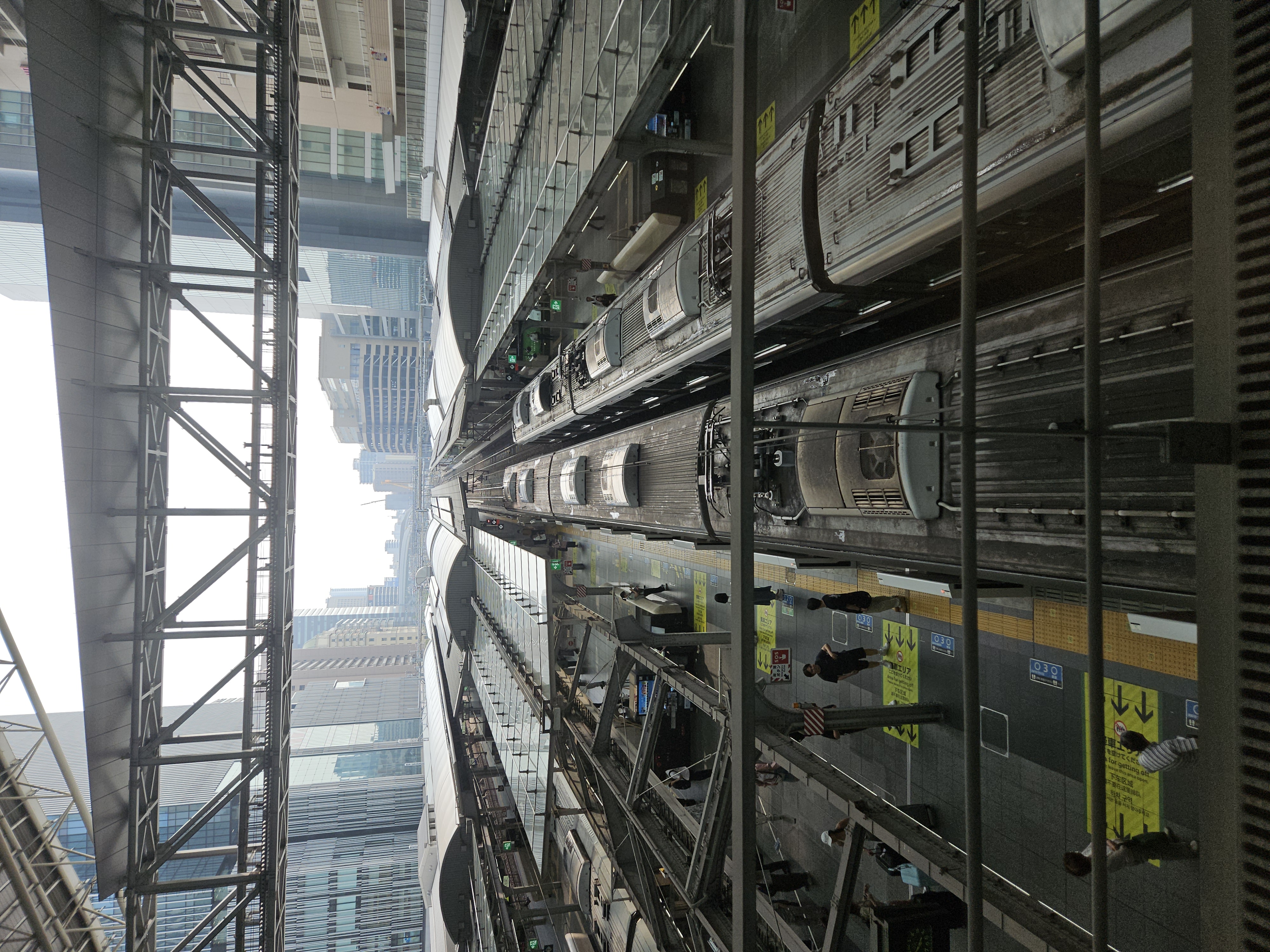
When I first stepped into the Sakaisuji Line heading north, I felt reminiscent of my past visits to Hong Kong. It was vastly different from what I experienced in the U.S. It was rush hour, and expectedly, the morning train arrived with a crowd. It left a deep impression. A crowded train was not an unfamiliar sight, yet when 10 cars, each 20 approximately yards in length, are packed with people, I was not only surprised but astonished. “Efficiency,” the word came to mind as I ruminated about its resemblance to Hong Kong. The railway system in Osaka screams of efficiency. Looking at the walls of the station, timetables are put up for passengers to reference. 90% of the time, the provided time is accurate. The train wastes no moment in transporting its passengers from between the stations.
When I was waiting for a train on the Midosuji Line, I noticed that they came one after another, in 1-minute intervals. The trains went by like the howling wind. This observation also brings up something different. What is behind the efficiency? It was the population’s profound dependence on rail as a major mode of transportation. The more I observed, the more I realized this dependence was both cause and effect of something uniquely Japanese. The efficiency I witnessed was not just about moving people; it was about moving customers. Major railroad companies in the Kansai regions profit from not only the railroad but the auxiliary industries. Walking in the commercial hubs of Osaka, it is hard not to notice the brandishing logos of private railroad companies atop major department stores. They occupied almost the entire landscape in Umeda, which used to be deemed the “northern outskirts” of Osaka City. As Mitchell Bring puts it, “[Umeda] is one of the most dramatic railroad-related cityscapes in Japan or anywhere else. [The five stations] in Umeda handle 2.3 million people per day.”
The predecessor of the Japan National Railways (JNR), the West Japan Railway Company (known as JR West), also participated in this horizontal expansion of the business model. The old Osaka Station is converted into the so-called Osaka Station City, incorporating chain restaurants, department stores, in the vicinity of the station exits.
Nonetheless, private railroad companies remained the dominant players in Osaka’s commercial landscape and the greater Keihanshin region. Their ventures extend beyond department stores around major stations. The Hanshin Tigers and Koshien, both sponsored by the Hanshin Hankyu Corporation, remain iconic symbols of Japanese sports culture. Private companies also wield considerable influence in the entertainment industry; the Takarazuka Revue, an all-woman theater group, is owned by the Hankyu Corporation. In this way, railway companies are omnipresent. The complexity of these private railway companies has expanded far beyond the brown steel tracks that became the city’s backbone. By integrating passenger transport with ancillary businesses, they built entire empires around their tracks. The most immediate examples, if department store logos weren’t already noticeable enough, were the endless lines of shops at the exits of major stations in Kyoto and Kobe. In Kobe, specifically next to the exit in Kosoku-Kobe Station, shops extend directly from the ticket gate, creating a visual and auditory stimulation of verbal soliciting and lights that felt almost overwhelming during my first encounter with the city. If I were a Japanese person, what would I think?